
 By: Deb Kitchenmaster
Let’s venture into an equine lab, look under a microscope, and learn some facts about parasites. Oh, come on now; it’s not that creepy. All horses are vulnerable to these organisms that live in or on an organism of another species (its host) and benefits by deriving nutrients at the other’s expense. There are many varieties such as roundworms, tapeworms, strongyles (large and small), and stomach bots. Internal parasites can be a health threat to horses.
So, what are some of your horse’s signals to you to bring about awareness your horse may have internal infestation?
- Weight loss
- Dull and rough coat
- Potbelly
- Coughing
- Diarrhea
- Tail rubbing
- Colic
- Decreased stamina and lethargy
It’s important to understand the life cycle of these parasites; in doing so, you can interrupt their life cycle. This is what you want. The internal parasites causing health problems for horses are large and small strongyles, roundworms, and tapeworms.
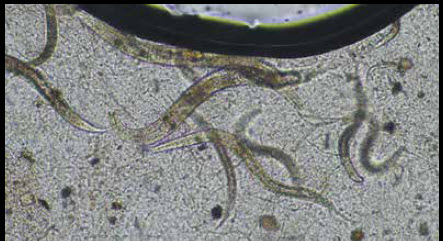
- Roundworm – A very large yellow-white worm. The female may be up to 15 inches long! This worm may pass in the feces of foals and young horses. Most adult horses develop immunity to these parasites. Roundworms primarily infect horses less than 2 years of age. The life cycle of the roundworm starts when the foal or yearling consumes grass or feed that is contaminated with the roundworm eggs or comes in contact with contaminated surfaces such as feeders, stall walls, or water. Adult females pass eggs into the horse’s feces, where they spend about 10 days in the environment before being capable of infecting a new host. With the correct temperature (77⁰-95⁰F/25⁰-35⁰C) the egg develops to second-stage larvae. These hardy larvae can persist for 5 to 10 years. The eggs hatch larvae that burrow into the small intestines. Once in the small intestine they mature to egg-producing adults, completing the life cycle. The life cycle takes about 3 months.
- Strongyles (large and small) – The eggs are found in the manure. The adult form of all strongyles lives in the large intestines then passed in the feces which contaminates the environment. These eggs develop into larvae that exist on the pasture grasses. The larvae molts three times before it is ready to infect the horse. The larvae use moisture on grass to crawl up the blades of grass to be more readily ingested. These larvae are very resistant because of a protective sheath. These parasites can survive freezing weather, but a hot and dry environment not so much. Larvae can survive up to 31 weeks at winter temperatures, compared to up to 7 weeks at summer temps. Strongyle larvae can only survive in the environment for around one year. Now that’s a good thing because it makes it easier to control through good management practices. The adult parasite will lay several thousand eggs each day, completing the life cycle. The entire life cycle takes 6 to 7 months.
- Tapeworms – The adult equine tapeworm is a flat worm around 3 inches long. The life cycle of this parasite requires an intermediate host, a tiny pasture mite that feeds on horse feces. This mite carries the eggs of the tapeworm. When the mite consumes tapeworm eggs in infected horses’ feces, the egg will develop for several months inside the mite until the infective stage of the tapeworm cycles. Another horse can then become infected with tapeworms by consuming grass or hay contaminated with mites containing this infective stage.
A simple and cost-effective approach dealing with parasites is to send a feces sample (1 tbsp.) to a lab to be checked. We mail our samples to be tested to The Natural Vet with Dr. Dan Moore (thenaturalvet.net). This is a safe way to know when to worm and when not to worm because the count in the feces indicates this. By locating the equine section of his website, you will find WORM CHECK. You can receive all the information you need for a parasite exam. You will also find an herbal equine supplement (satisfaction guaranteed) at www.thenaturalvet.net P.O.Box 429 Unicoi, TN 37692, phone 1-877-873-8838.
Please note that parasites are the most active during a full moon. So work with this time for worming.