

 By: Bob Felgar
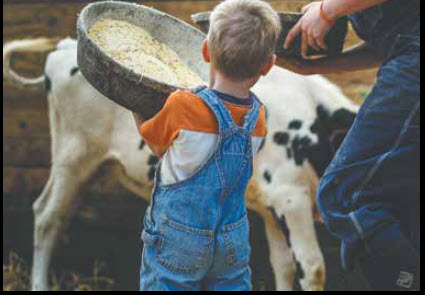
Every youngster born on the farm soon learns what chores are. By age 3, the young one may be sitting on big brother’s shoulders with their hands holding desperately onto the mop of hair at their fingertips.
By that time, the little one already knows how to sound like a chicken, a horse, and a cow. On our farm in rural Illinois, you could add pigs and rabbits to that list.
When I realized as a 6-year-old that not everyone lived on a farm and had all these chores, I was envious. Some of my city classmates didn’t even have to take out the trash let alone be up and in the barn by 0530 to milk cows… no automatic milkers, just 2 strong hands. The pigs, chickens, and four pens of rabbits had to be fed and watered all before breakfast close to 0700. The bus I rode to Elvaston School was parked on our property close to the windmill. The Hancock county school bus drivers were responsible for the overnight care of the buses they were assigned. My dad, Lynn E. Sr. drove a school bus route for about 30 years. I rode faithfully one full year before I could enroll in that small elementary school. My job was to operate the interior lever that caused the exterior stop sign to signal oncoming traffic to stop while young passengers boarded Ol’ Yeller.” That may have qualified as a chore because it was a routine, but having the power to stop oncoming cars with one simple lever was my first feeling of power.
During high school when my classmates were practicing basketball or baseball after school, I was headed home for that day’s assigned list. There were no options.
My bus route from school to my house was not a driveway stop. It stopped 3/4 of a mile and my “shanks ponies” brought me home, rain or shine.
Did I resent all those chores that kept me from playing on the Cardinals teams? Yes. I would be lying if I said otherwise. Did I feel cheated when my city classmates never made any reference to doing anything around their house? I’m guessing that over 65% of our graduating class of ‘59 were farm teens. Even when I bought my first car as a junior at HHS, I still swapped my ‘49 Chev steering wheel for a larger tractor steering wheel to plow, disc, or harrow in the South 40.
I was not able to discern any notable, personal advantage for doing all those chores all those years.
Yes. I remember the commercial milk truck driver give Dad a check for the 10-gallon stainless-steel cans full of Bert’s, Star’s, and four other cows’ milk, hand-squeezed and ready to be placed in the large Ford truck. I was beginning to realize that the milk check bought groceries that were not produced on that 90-acre farm.
It wasn’t ‘til much later that I realized that one reward for all that lost sleep, for the loss of not playing school sports was not measured in accolades or in a shared team trophy but in something intangible and far more valuable — discipline. The ability to do something twice daily for a lot of years when I didn’t want to do it and with no immediate reward in my hand was a principle that I have come to appreciate.
The next principle I learned was a strong work ethic. Most if not all my first employment outside the farm were jobs requiring focused and disciplined work habits. I was rewarded with promotions and an increase in pay. Other employees my age were not recognized; they were not promoted and became negative; they “sluffed off” at work, always looking for ways to get out of fulfilling their agreed-upon job role.
Another present tense benefit of growing up on the farm is creativity. I did look for ways to do my job better or more efficient whether pumping gasoline at 19 cents a gallon earning $1.15 an hour or working on an assembly line of a lawn mower manufacturing plant not a 1/2 block from my city home. We had left the farm and moved into town the summer before my senior year.
You have no doubt heard the old sage expression that states: “You can take the boy out of the country but you sure can’t take the country out of the boy.”
Were those years on the farm between 1946 until 1958 rough? Absolutely. Could I have learned so many life principles if I lived in town all those years? I want to avoid negativity, but I can’t think of a single household task that would demand real early hours even on weekends, any activity that had to be completed routinely every day without fail… even Christmas.
1947-1959
Am I glad that those days are in my past even with all the character-building hours feeding animals, breaking ice to provide water before it refroze, and struggling to follow my older brother’s long deep boot prints through the 9” snow that occurred between 10 p.m. and before the alarm went off at 0415?
2026 Yes I am.
Then maybe you can explain to me why in the world (85 this October) would I have my friend Speckles and seven of her egg-laying friends and three hair sheep (Sunshine, Lily, and Freckles) in the back yard of my 1/2 acre lot on a quiet cul-de-sac snuggled in a peaceful subdivision in Madison, AL?
I am in urgent search of a way that we can collectively teach the generations to follow that:
#1. Work is not always fun but it produces creativity, a strong work ethic, a habit of discipline needed for the remainder of their short life here on earth.
#2. It provides the truth that work or labor brings rewards in terms of recognition, promotion, leadership skills, and even attracting a similar-minded mate when that time comes.
Now what? Every life lesson I learned has its foundation in the Book that Jesus left for us. Where do you get your encouragement, direction, and wisdom in making tough decisions? Passed on by parents, grandparents, and you great grandparents. If you have young children, give them some chores but include an appropriate reward for neatness or cleaning up their space. And don’t forget bedtime prayers.
If you have grandchildren, invest valuable time with them. Use your own unique way to give them something to read or to remember after you are no longer here to teach them yourself. Meal-time prayers. Night time prayers. Emergency time prayers whether it’s an actual emergency or a disappointed little girl or boy who doesn’t understand that life can be cruel.
If you are blessed with great grandchildren, give them a large portion of your life lessons on their level.
Encourage them to respect others, read Bible stories to them and hold and hug them ‘til the cows come home.
This isn’t just a nice-sounding platitude but a serious level of encouragement. Whatever life stage you find yourself in today, consider this your chore. Not a one-n-done task but a specific everyday routine. A chore.
By: Bob Felgar