

By: Jennifer Lord
The Bible teaches that “the righteous care for the needs of their animals.” In a state where Christian faith plays a central role in public life, that principle should guide our laws as much as our personal beliefs. Yet Alabama has consistently ranked among the worst states for animal cruelty protections, raising serious questions about whether our laws reflect the compassion we claim to value.
Despite Alabama’s poor ranking for animal cruelty protections, this moment offers hope. House Bill 446 was introduced on February 12, 2026, to the Agriculture and Forestry Committee. Our community has an opportunity to speak clearly to our elected leaders and say that we expect better. We can choose laws that protect animals, reflect our values, and show that compassion still has a place in Alabama policy.
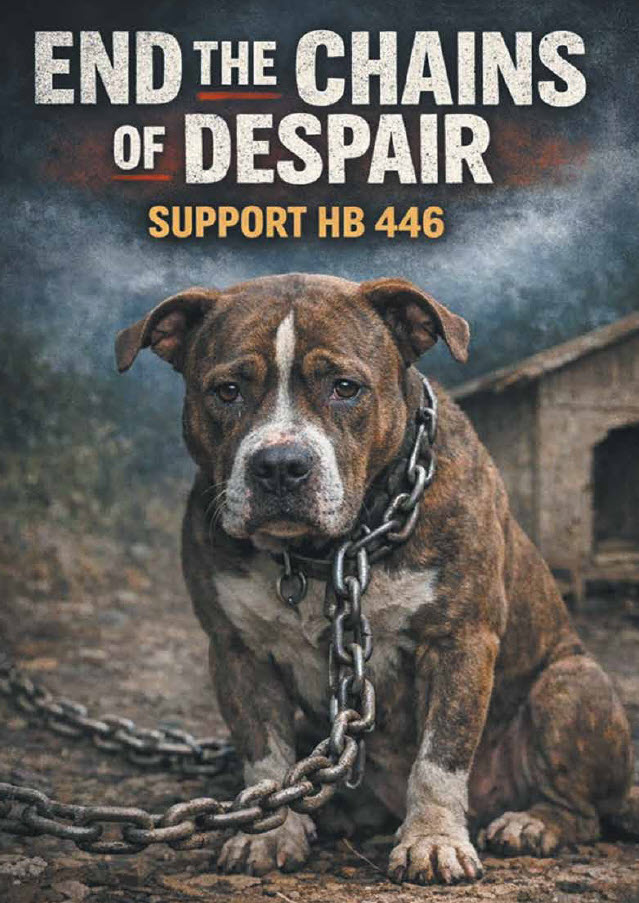
Alabama House Bill 446 (HB 446), also called the Alabama Dog Tethering and Outdoor Shelter Act, is proposed legislation aimed at strengthening protections for dogs kept outside. It would:
- Restrict how dogs can be tethered or chained to stationary objects like trees, posts, or houses unless specific conditions are met.
- Require safe outdoor care — for example, dogs must be in secure enclosures (like fenced yards or approved trolley systems), have proper shelter, and access to food and water.
- Set standards for tethering equipment (e.g., harnesses that don’t choke and tethers of appropriate length/weight).
- Include exemptions for activities like hunting, herding, training, grooming facilities, or temporary tethering at campsites.
- Create penalties for violations, classified as a Class B misdemeanor if someone fails to meet the bill’s requirements.
In short, HB446 would make Alabama’s laws more specific and enforceable about humane outdoor care for dogs, addressing problems like long-term chaining without protection from weather or adequate resources.
There isn’t a specific statewide Alabama law that clearly says a dog must have a doghouse or a defined type of outdoor shelter. At the state level, what exists are general animal cruelty provisions that say a person cannot deprive an animal of “necessary…shelter,” but they don’t spell out exact requirements (like a doghouse with minimum dimensions, insulation, etc.) the way some local ordinances do.
Under Alabama’s animal cruelty statute (§ 13A-11-241), it’s unlawful to deprive a dog of necessary … shelter in a cruel manner. That means a dog must have reasonable protection from weather and conditions that could cause suffering. But the statute doesn’t define “necessary shelter” with specific measurements or features.
Alabama doesn’t currently have a clear, detailed statewide requirement that every dog kept outdoors must have a doghouse or specific type of housing. The anti-cruelty language is broad, which makes enforcement subjective and dependent on local animal control’s interpretation.
Over the years, I have contacted Limestone County Animal Control countless times to report dogs left outdoors without proper shelter. I was repeatedly told that if a dog can crawl under a car or mobile home, it counts as “shelter.” I have also spoken directly with the Limestone County Sheriff’s Office and received the same explanation. This interpretation of the law exposes a serious gap in Alabama’s animal welfare protections—and it is one that animals are paying for. Dogs deserve better in Limestone County and across our state.
Alabama is at a crossroads. (HB 446) is more than a piece of legislation — it’s a moral imperative. The bill is sponsored by Representative Phillip Ensler, seeks to establish clear, enforceable standards for how long dogs are tethered and sheltered outdoors. Passing HB 446 would not only protect animals from unnecessary suffering but also strengthen public safety and modernize our state’s approach to animal welfare.
Across Alabama, countless dogs spend their lives chained to stationary objects, exposed to scorching summers and freezing winters, often without adequate food, water, or shelter. Current laws are vague, leaving law enforcement and animal control officers little power to intervene until tragedy strikes. HB 446 changes that by setting humane, practical standards for outdoor confinement. These guidelines are not radical; they are common sense measures already adopted in many states.
“Why does it matter?” I am glad you asked. Dogs are social creatures that suffer physically and emotionally when chained for long periods of time. HB446 prevents needless suffering and promotes responsible pet ownership. Empowering law enforcement with clear definitions of neglect and abuse give tools they need to act before a situation becomes life-threatening for the animal and community. Neglected dogs often become aggressive or attempt to escape, creating hazards for neighbors. Humane confinement reduces this risk, enhancing public safety and making communities safer. States across the country have passed similar laws. By adopting HB 446, Alabama signals its commitment to compassion and progress and aligns Alabama with modern standards.
Opponents may argue that this bill imposes burdens on pet owners. In reality, HB 446 asks for the bare minimums: shelter from the elements, safe tethering practices, and basic care. Failing to act means continuing the cycle of neglect, suffering and preventable tragedies.
HB 446 is not just about dogs — it’s about who we are as a state. Do we value compassion, responsibility, and safety? Or do we allow outdated practices to persist at the expense of animals and communities? Lawmakers have a chance to make history by passing HB 446. By reaching out to our state legislators through email or phone, our community can express concern for our animal companions and advocate for positive change in Alabama.
By: Jennifer Lord