

 By: Ali Elizabeth Turner
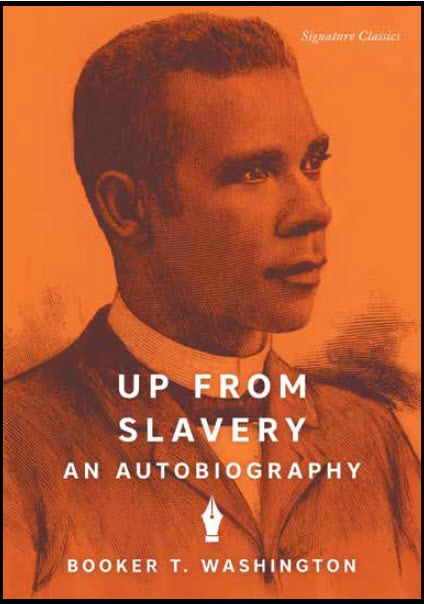
I feel like I am in the midst of a continual Christmas morning. For the last 10 days or so, I have been slowly and blissfully partaking of an ongoing feast in the form of Booker T. Washington’s Up From Slavery. I had known about the book from my 6th grade social studies class, was aware that it is the autobiography of one of America’s (and Alabama’s) great men, but had no idea how profoundly I would be affected by its pages.
Booker T. Washington (who, by the way chose his own name as a kid) was nine years old when the Emancipation Proclamation was issued in 1865. He had no idea who his father was; was illiterate and within 40 years had finished college himself; created an institution of higher learning that had produced more self-made millionaires than Harvard, Yale, and Princeton combined; had visited Presidents McKinley and Theodore Roosevelt; had been visited in Tuskegee by Presidents McKinley and Roosevelt; and was given an honorary doctorate by Harvard that made national news, appearing on the front page of the New York Times.
Now, consider that all of the above-mentioned accomplishments happened smack dab in the blight that was Jim Crow. Let’s talk about Tuskegee itself. When Up From Slavery was published, Tuskegee Institute was debt free and worth about 1.75 million. There was a million-dollar endowment and 750 acres of land. The students built the buildings, and the school schedule was from 5 a.m. until 9:30 p.m. Booker insisted that graduates be masters of two trades before they finished school. This was so when they left school they could start businesses and not have to work for anyone else.
We need to take a moment to mention the concurrent accomplishments of Booker T.’s colleague George Washington Carver. He arrived at Tuskegee in 1896 and taught there for the next 47 years until his death. He was an accomplished pianist and painter, and exhibited at the 1904 World’s Fair held in St. Louis. He had more than 300 inventions, did extensive research on sweet potatoes and peanuts, and when he died, he donated his savings of $60,000 to seed the George Washington Carver Foundation to assist students in their education.
No discussion of Booker T. Washington would be complete without an understanding of his progeny. Booker T. had three children, two grandchildren, and three great-grandchildren. They were accomplished, and the story of his great-granddaughter, Sarah Washington O’Neal Rush, is fascinating. Dr. Rush was the child of a single mother in Oakland, and became a teen mother herself. Her mom never mentioned anything about her great-grandfather, and it was Sarah’s trip to Tuskegee that served to function like an epiphany. It was there that she got in touch with her heritage, and she has gone on to get her Ph.D., has written a book entitled Up From The Blood, which talks about her heritage, and she is a strong believer. I do believe Booker T. would be proud of his great-grand girl. And, for my part, I want to absorb everything I can about Tuskegee, visit it soon, and let its amazing story make me stronger and better.