

 By: Ali Elizabeth Turner
Sometimes I find comfort (especially when it seems like the planet and its people are pitching to and fro) in learning about impossible feats of courage that were exemplified during WWII by the Greatest Generation. This edition of Soldier is to give hope that a life of service that was well-lived and full of outrageous, courageous adventure can inspire us long after the hero has breathed their last.
Such was the life of Joseph Foss who, before he died in 2003, became a general in the United States Marine Corps, a Medal of Honor recipient, president of the National Rifle Association, the first commissioner of the National Football League, a two-term governor of the state of South Dakota, had his own television show, was director of public relations for KLM Royal Dutch Airlines, and was a sought-after public speaker.
Joe was born in South Dakota in 1915, and his father was killed in an electrical storm when he was 18. Joe and his brother helped their mom keep things together, and then WWII began to threaten to roll in. In 1940, Joe hitchhiked 300 miles from his home to Minneapolis in order to join the Marines who participated in the Naval Air Corps training program. He completed his training in March of 1941, just a few months before the attack on Pearl Harbor. Joe was sent to Pensacola to complete his training, and became a flight instructor. He became a first lieutenant in April of 1942, and shipped out to Guadalcanal in September of 1942.
Joe’s squadron was in what was known as the “cow pasture,” due to the amount of mud there, and the airfield saw a lot of strafing. They had 19 Wildcats and 12 Douglas SBD Dauntless dive bombers. Joe’s first contact with an enemy airman was in October, and while he was successful in shooting down the Zero, his plane had been hit and Joe plummeted 22,000 feet and managed to do a dead-stick landing.
Joe was back in the sky the next day, and began to be considered an “ace” real quick. He shot down plane after plane within the first few weeks, and then he got hit. He was headed to the water, and things did not look good. As Joe’s biographer, Michael Hull tells it:
When the Wildcat hit the sea, the impact slammed the canopy shut. Struggling desperately with the latch as water rose to his chin, Foss was finally able to pop it and rise to the surface, buoyed by his parachute pack and Mae West lifejacket. He started swimming toward Malaita, two miles distant. Sharks circled him and darkness fell.
“I did more praying that afternoon out there than I ever did in my life,” Joe remembered. When the sharks came closer, he tore open a pouch of chlorine powder and sprinkled it into the water to repel them.
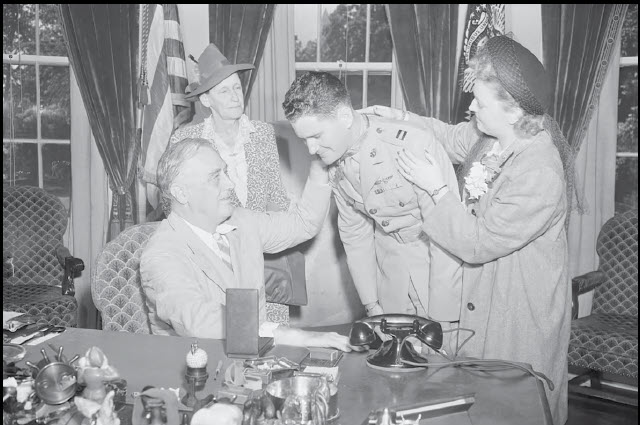
It was the “aquatic aviation adventure” that earned Joe the Medal of Honor which was presented in the Oval Office by FDR. Ironically, just after 9/11, General Foss was flying out of Sky Harbor in Phoenix on his way to a speaking engagement at West Point when he was not allowed to board the plane with his medal around his neck. He had to ship it home at his own expense. No one recognized him or his medal, but he was unfazed. His only concern was that the symbolism of the medal was not recognized 60 years later, and he was not interested in his own fame. He died not long after from a brain aneurysm, and I am more than happy in this new year of 2026 to re-introduce a generation to a true hero of the Greatest Generation, Joe Foss.
By: Ali Elizabeth Turner